Apple Is Finally Letting You Choose Your Own AI And It Changes Everything
You know how Apple is always late to the party in the world of smartphone innovation?
Foldables — Samsung has been doing this since 2019. Apple’s foldable iPhone is still rumoured for 2026/2027. High refresh rate displays — Android flagships had 120Hz years before iPhone 13 Pro. Always-on display — Android had it long before iPhone 14 Pro. Under-display fingerprint sensors — still not on iPhones. Rollable screens — Samsung and LG have explored this; Apple hasn’t even started.
But all that is about to change — and this time, the thing Apple is late to might actually be the most important innovation of the smartphone era.
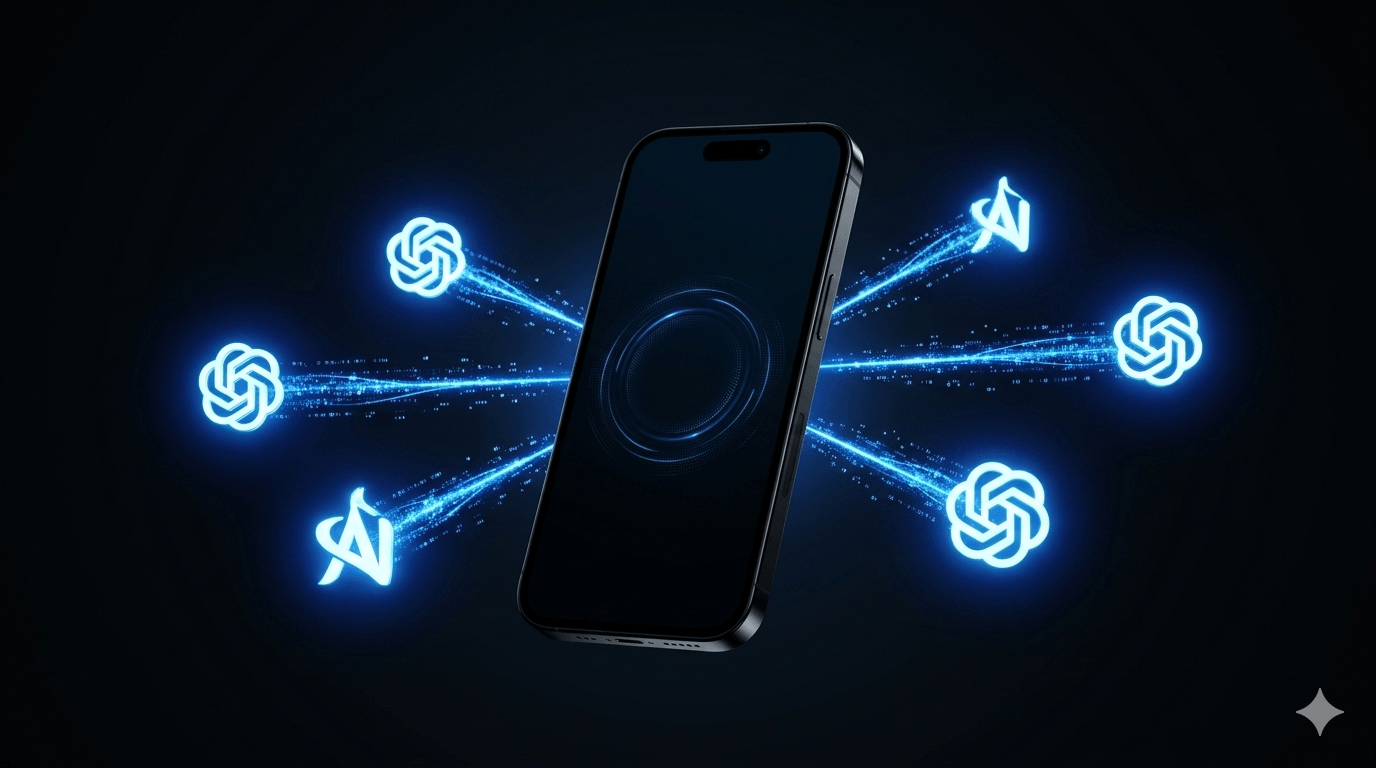
Apple is planning to let you choose from different third-party AI providers — like Google’s Gemini or Anthropic’s Claude — to power features across your iPhone, iPad, and Mac. The change arrives with iOS 27, iPadOS 27, and macOS 27 this fall.
This is not a small software update. This is a fundamental shift in how Apple thinks about its relationship with you as a user. And it matters more than most people realise.
What Is Actually Changing?
Right now, if you own an iPhone, Apple decides which AI powers your experience. Siri is Siri. Apple Intelligence is Apple Intelligence. You get what Apple gives you — nothing more, nothing less.
Starting this fall, that changes completely. Instead of one AI provider baked into your device, you will be able to select from a menu of AI options — Google Gemini, Anthropic’s Claude, and potentially others — to handle different tasks on your phone.
Think of it like choosing a browser. For years, Safari was the only real option on iPhone. Then Apple was forced to allow alternatives and millions of people switched to Chrome, Firefox, or Brave based on what worked best for them. AI on your iPhone is about to work the same way.
Want Claude to handle your writing and email composition? Choose Claude. Prefer Gemini for research and Google integration? Choose Gemini. Trust Apple Intelligence for certain private tasks? Keep it for those. The choice becomes yours.
Why Is This A Big Deal?
To understand why this matters, you need to understand what AI actually does on your phone today.
AI is no longer just a chatbot you occasionally talk to. In 2026 it powers your autocorrect, your photo editing, your email summaries, your calendar suggestions, your search results, your notification prioritisation, and increasingly your voice interactions. The AI running on your phone is making hundreds of small decisions about your experience every single day — invisibly and automatically.
When Apple controls which AI does all of that, Apple controls a significant portion of your daily digital experience. That’s an enormous amount of power concentrated in one company’s hands.
By opening the door to third-party providers, Apple is effectively decentralising that power. Different AI models have different strengths. Google’s Gemini is deeply integrated with search and Google’s vast data ecosystem. Anthropic’s Claude is widely regarded as the most careful and nuanced AI for complex writing and reasoning tasks. Having the freedom to match the right AI to the right task — on your own terms — is genuinely powerful.
What This Means For You Personally
Let’s make this concrete. Here’s how this change will play out in your daily life once iOS 27 lands this fall:
Your phone gets smarter in the way you actually want. Different people use their phones differently. A lawyer needs precise, careful AI for document work. A creative professional wants imaginative, expressive AI for writing and ideation. A student needs clear, patient explanations. No single AI model is best for all of these — but now you won’t have to settle for one.
Competition drives improvement. When Google, Anthropic, OpenAI, and others are competing directly for your choice on your iPhone, they are incentivised to build better, faster, and more private AI experiences. You benefit from that competition in ways you would never benefit from a monopoly.
Your privacy preferences can finally be honoured. Different AI providers have very different approaches to your data. Anthropic’s Claude, for example, is built with a strong emphasis on safety and privacy. If that matters to you — and it should — you can choose the provider whose values align with yours rather than accepting Apple’s default.
Personalisation becomes real. As you rightly pointed out — this brings a genuinely personalised experience to every iPhone user. Two people with identical iPhone models could have completely different AI experiences based on their choices. That is a level of personalisation smartphones have never offered before.
Will Other Brands Follow?
Absolutely — and some already are.
This is the trend you correctly identified. Once Apple — the most influential consumer technology company on earth — legitimises the idea of user-selectable AI providers, the rest of the industry follows. It happened with app stores, with wireless charging, with NFC payments, and with USB-C. It will happen with AI providers too.
Samsung will likely announce a similar feature within 12 months of iOS 27 launching. Google’s own Pixel phones may build a more open AI selection model into Android itself. Once this becomes an expected feature on premium phones, it cascades down to mid-range and budget devices within two to three years.
What Apple is doing this fall is setting the standard for how AI will be integrated into smartphones globally for the next decade. That is not an exaggeration.
What Should You Do Right Now?
iOS 27 isn’t here yet but there are smart moves to make today:
1. Familiarise yourself with the main AI providers now. Before fall arrives, spend time with Google Gemini, Anthropic’s Claude, and ChatGPT. Each has a free tier. Understanding their strengths and differences now means you’ll make a more informed choice when iOS 27 gives you the option.
2. Think about what you actually use AI for. Writing? Research? Photo editing? Voice commands? Knowing your primary use cases helps you pick the right provider when the choice is available.
3. Pay attention to privacy policies. When choosing your AI provider, read — or at minimum search for a plain-language summary of — their data policy. Who stores your conversations? For how long? Is it used to train their model? These questions matter more when AI is woven into everything your phone does.
4. Watch the iOS 27 announcement closely. Apple’s annual developer conference WWDC typically happens in June. That’s where the full details of iOS 27’s AI provider options will be announced. Follow TouchTech — we’ll break it down for you the moment it happens.
Apple being late to the party has always been its strategy — arrive after everyone else, but arrive with the version that the whole world actually uses. If that pattern holds, the AI provider choice coming in iOS 27 won’t just be a feature. It will become the new normal for every smartphone on earth.
At TouchTech we track every shift like this one and translate it into what it means for your phone, your privacy, and your daily life. Subscribe to our newsletter below and be the first to know when iOS 27 drops — and exactly which AI provider you should choose for your needs.