The Pentagon Just Gave 7 Big Tech Companies Access to Military AI Here’s Why That Affects You
When the military and Silicon Valley shake hands, most people shrug and scroll past. But this week’s news deserves your attention — because it tells us something important about where AI is really heading and who is ultimately in control of it.
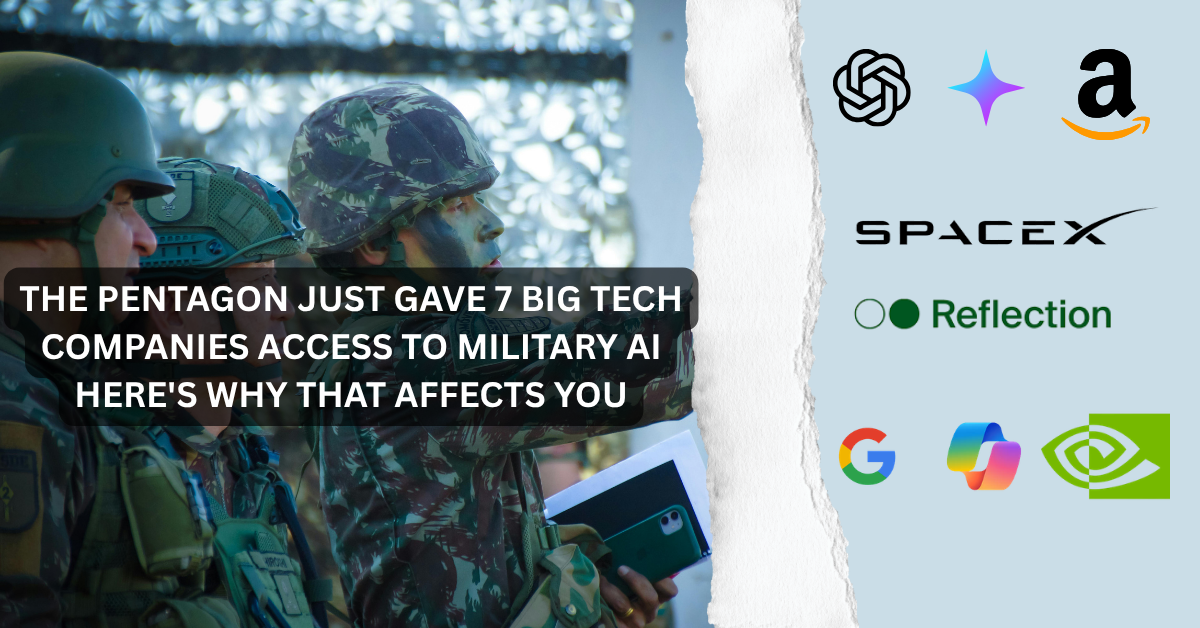
The US Department of Defense announced an agreement with seven major technology companies to use their artificial intelligence tools in its classified networks. The companies involved are household names — Elon Musk’s SpaceX, ChatGPT-maker OpenAI, Google, Microsoft, Nvidia, Amazon Web Services and Reflection.
This is not a small deal. This is Big Tech embedding itself into the most powerful military institution on earth. And whether you live in the US or not, that has implications for everyone.
What Actually Happened?

The Pentagon — the headquarters of the United States military — has officially signed agreements with seven of the world’s biggest tech companies to bring their AI tools into classified government networks. These are networks that handle sensitive, top-secret military information.
In plain terms, the AI tools you use every day — ChatGPT, Google’s Gemini, Microsoft’s Copilot — are now also being used to assist military decision making at the highest levels.
What makes this story even more interesting is who was left out. Anthropic, the maker of the Claude AI assistant, was not included — blacklisted by the Trump administration over Anthropic’s insistence that the Pentagon include certain safety guardrails for the government’s use of AI in warfare.
Read that again. A major AI company was excluded from a billion dollar government deal because it insisted on safety rules for how AI should be used in war. That tells you everything about the tension at the heart of this story.
Why Should You Care If You’re Not American?

Fair question. Here’s why this matters to everyone:
The companies involved are the ones building the tools you use daily. OpenAI makes ChatGPT. Google makes Gemini and Search. Microsoft powers Copilot and Office. Amazon runs the cloud infrastructure that half the internet sits on. When these companies take on military contracts of this scale, it shapes their priorities, their research direction, and ultimately the products that reach your hands.
It sets a global precedent. When the world’s most powerful military adopts AI at this level, other governments follow. Nigeria, the UK, China, India — every major government is watching and drawing their own roadmap. The decisions made in Washington this week ripple outward to every country within months.
It raises serious questions about AI safety. The fact that Anthropic was excluded for wanting safety guardrails tells you that some of these companies agreed to operate without those same guardrails in military contexts. AI making recommendations in warfare — with reduced safety checks — is something every person on earth has a stake in.
Your data and privacy are connected. The same companies that hold your emails, your searches, your photos, and your messages are now operating inside classified military systems. The line between consumer AI and military AI is blurring fast.
The Bigger Picture — Who Controls AI?
OpenAI is no longer just a model lab — it is becoming a full-stack business machine with product, cloud, government, coding, education, and platform ambitions all moving at once.
This Pentagon deal is the clearest sign yet that AI has moved from a consumer product to critical infrastructure. The same shift happened with the internet in the 1990s and smartphones in the 2000s. In both cases, the technology started as something exciting and accessible — and gradually became something deeply embedded in systems of power and control.
We are watching that same transition happen with AI right now, at extraordinary speed.
The key question is not whether AI will be used in military and government systems — that ship has sailed. The real question is whether there will be meaningful rules, oversight, and accountability for how it is used. Right now the answer is unclear, and that uncertainty should matter to all of us.
What Can You Do About It?

You are not powerless here. Here are practical things worth doing:
Stay informed and think critically. The fact that you’re reading this is already a step ahead of most people. Understanding what is happening with AI at a policy and institutional level helps you make better decisions about the tools you use and trust.
Diversify the AI tools you use. Relying entirely on one company’s AI ecosystem — especially one now deeply embedded in government contracts — is a risk. Explore alternatives and understand what each company’s values and policies actually are.
Pay attention to AI regulation news. Decisions being made in governments right now about AI will affect your privacy, your rights, and your opportunities for years to come. These are not boring policy stories — they are the rules of the road for the most powerful technology ever built.
Support companies that prioritize safety. With your attention, your subscriptions, and your choices, you vote for the kind of AI future you want. Companies that stand firm on safety — even when it costs them contracts — deserve that support.
The Pentagon’s AI deal is not just a Washington story. It is a signal about where the most powerful technology in human history is heading — and who is steering it. At TouchTech, we believe you deserve to understand these shifts clearly so you can navigate them on your own terms.
Subscribe to our weekly newsletter below and we will keep breaking down the stories that matter — in plain language, with real context, every single week.